Preparing for an Effective Board of Directors Meeting
Economic Substance & Tax Residency in Singapore: A closer look at Control and Management
In our earlier article, “Economic Substance & Tax Residency for Companies in Singapore”, we explored how a Singapore company’s tax residency is determined, that is, by several factors not just by its country of incorporation. One of the most critical components of economic substance is where the control and management of the business of the company are exercised.
In practice, this is often shown by how and where Board of Directors’ Meetings are held.
A properly conducted board meeting can demonstrate that strategic decisions are genuinely made in Singapore, thereby supporting the company’s commercial substance in Singapore.
What Should You Prepare Before a Board Meeting
1. Setting the Agenda – The First and Most Important Step
The agenda is the cornerstone of a board meeting. It sets the direction of board discussions and evidences the nature of decisions being made. From a control and management standpoint, the agenda should focus on strategic matters, rather than purely administrative or operational updates.
Typically, the agenda is prepared and approved by the CEO or Chairman of the Board, reflecting their leadership role in driving the company’s strategic direction.
Key considerations when preparing the agenda:
- What are the strategic matters to be discussed?
- Do the agenda items require board-level decision-making?
- Are the agenda items aligned with the company’s long-term objectives?

An agenda that does not provide strategic direction for board discussions held in Singapore may undermine a company’s position to demonstrate that meaningful control and management are exercised in Singapore.
2. Standard Board Meeting Agenda – What Should Be Included
While the agenda may vary depending on the company’s size and industry, a standard board agenda typically includes:
- Confirmation of minutes of the previous board meeting;
- Any matters arising from previous board meeting, including follow-up actions taken and further decisions/conclusions made after the previous board meeting;
- Review of financial performance, including management accounts and cash flow;
- Strategic planning and business directions, for example, business plan review, growth strategies, market entry or exit decisions and group restructuring;
- Approval of key commercial decisions, including significant contracts, investments or divestments, financing arrangements and any other commercial activities that outside the scope of usual commercial activities of the company;
- Reporting of risk management and compliance matters; and
- Any other business requiring board’s approval.
These agenda items for board meetings held in Singapore demonstrate that the board is actively involved in steering the business and making high-level decisions in Singapore.
3. Planning the Board Meeting Process
Beyond the agenda, it is important to establish a clear and consistent process for convening board meetings. This includes:
- Setting the meeting date sufficiently in advance and ensuring that sufficient notice period is given and where the notice period is set out in the constitution of the company, is in accordance with the constitution of the company.
- Determining the meeting location, taking into consideration that the Directors are majority present in Singapore and the majority of the Board Meetings held in a calendar year are held in Singapore.
- Deciding the meeting format (whether fully physically or fully virtually or hybrid)
- Circulating board papers and materials for discussion and decision consideration ahead of the meeting.
Proper process planning strengthens the company’s position that strategic control is exercised in Singapore, not mere paper documentations of the board meetings.
4. Location and Method of Holding the Meeting
From an economic substance perspective, where and how the board meeting is held matters. While virtual meetings are increasingly common, companies should ensure that their board meeting practices meet commercial substance expectations, particularly in relation to physical presence.
Whether the meeting is held in Hybrid or Physical mode, it would be good practice to record the meeting for both internal references and as proof that the board meetings are held in Singapore for tax purposes.
Proper planning should address:
- Which directors will be physically present in Singapore
- Whether the Chairman or key decision-makers are attending in Singapore
- Whose participation, their attendance and location are clearly recorded in the minutes
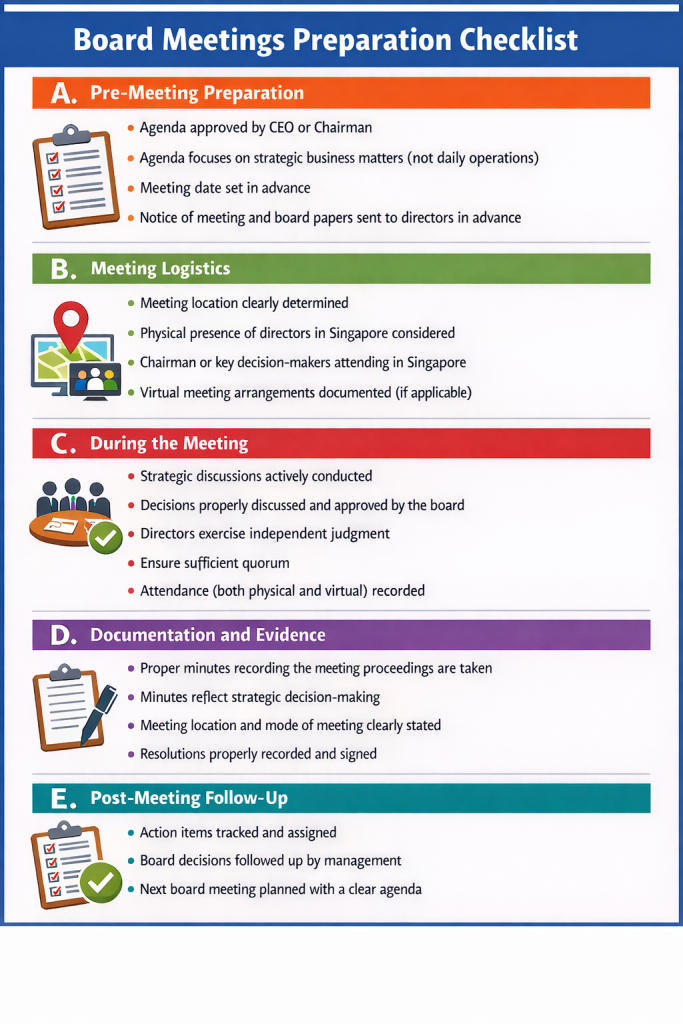
A Simplified Board Meetings Preparation Checklist is Annexed for Reference
If you have any questions, please email to:-
Funds-related inquiries
Jocelyn <jocelyn@prestigefiduciary.com>
Zoey <zoey@prestigefiduciary.com>
Shi Ning <shining@prestigefiduciary.com>
Sales inquiries
Dong Neng <dongneng@prestigefiduciary.com>
Xiao Yan <xiaoyan@vodich.com.sg>
Clarissa <sales@vodich.com.sg>
Tax inquiries
Siew Chui <susan@vodich.com.sg>
General inquiries
Puay Siang <puaysiang@vodich.com.sg>